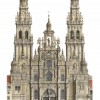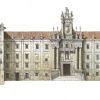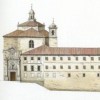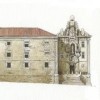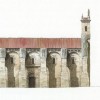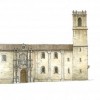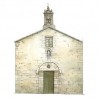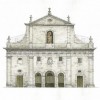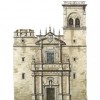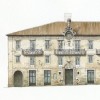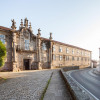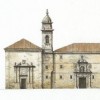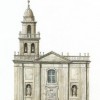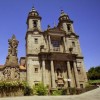
Convent of Santa Clara
17th c. Baroque Its origin as a convent goes back to the 13th century, although its present-day structure is the result of a baroque reconstruction that was completed in the 17th... read more
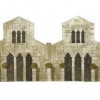
Collegiate Church of Santa María a Real do Sar
12th c. Romanesque Built in the 12th century on the banks of the River Sar, it is the church, along with the Cathedral, that still has the greatest proportion of its original... read more
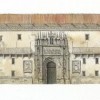
Colexio de Fonseca
16th c. This school was commissioned by Archbishop Alonso de Fonseca, converting the house where he was born and which belonged to his influential family for educational... read more
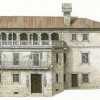
Casa Gótica (Gothic House)
14th c. This building, also known as 'Casa do Rei Don Pedro', is an example of Compostela's 14th-century civil architecture. The ground-floor entrance and a window with... read more
Pazo de Xelmírez
12th c. Romanesque. This Bishop's Palace, attached to the north side of the Cathedral and facing Praza do Obradoiro, was commissioned by Archbishop Diego Xelmírez in order to... read more
Pazo de San Lourenzo de Trasouto
18th c. This palace is located behind the luxuriant oak grove of San Lourenzo and was commissioned by Martín Arias, the bishop of Zamora, in the 13th century. It was... read more
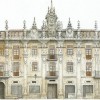
Pazo de Bendaña
Mid-18th c. Baroque. Urban palace designed by Clemente Fernández Sarela and built for the Marquis and Marquise of Bendaña. It was finished in 1759. It stands out because... read more
Convent and Church of Madres Mercedarias
17th c. Baroque-neoclassical The Convent of the Mercedarian Mothers is located outside the historical quarter, in the street Fonte de Santo Antonio, facing the Gate of Mazarelos,... read more
Church of San Fructuoso
18th c. Baroque Known as the Church of Las Angustias de Abajo, La Real Angustia or simply San Fructuosa. This churrigueresque church was designed by Lucas Ferro Caaveiro in the 18th... read more
Food Market
Santiago's present-day Food Market was built in 1941. The previous City Market, which was demolished in 1937 to make way for the current building, was the first permanent structure housing the... read more
Convent and Church of Santo Agostiño
17th c. Baroque The Church of San Agustín is located in the square of the same name. It was built in the mid-17th century with money that the Count of Altamira donated to the... read more
Convent and Church of San Domingos de Bonaval
CHURCH 14th c. Gothic with Romanesque influence The church was built in the 14th century according to the canons of mendicant architecture. It consists of three naves separated by... read more
Convent of Carme
18th c. Baroque This discrete and austere baroque convent from the 18th century is situated at the junction of the streets Os Loureiros and Santa Clara. Its most outstanding feature... read more
Former Hospital and Church of San Roque
HOSPITAL 16th c. At the top of Rúa das Rodas, where Rúa de San Roque begins, we can see this 16th-century building that was transformed in the 18th century. It was... read more
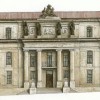
Facultad de Geografía e Historia
18th Century. Neoclassical. This neoclassical building of huge columns was erected with drawings of Melchor de Prado between 1769 and 1805, on the site that had occupied the College of... read more
Monastery and Church of Santa María de Conxo
Church: 17th c. Baroque. Romanesque cloister. The Monastery of Santa María is located in the centre of the Conxo neighbourhood. According to tradition, it was founded by a woman... read more
Convent and Church of San Francisco
17th c. Baroque The Convent of San Francisco de Valdediós was founded by St. Francis of Assisi during his visit to Santiago de Compostela in 1214, at the place called Val de... read more
Convent of Belvís
14th c. Baroque. Founded in the 14th century by Teresa González, it was rebuilt during the baroque period by the Mexican archbishop Monroy, who belonged to the Dominican order.... read more
Hostal dos Reis Católicos
16th century.
The construction of the present-day building was commissioned in 1501 by the Catholic Monarchs in order to take care of the sick and the pilgrims of the divine Xacobe, according to... read more